Table of Contents
- What Drives Your Water Heater Replacement Cost Estimate
- Tankless vs Tank Water Heater Cost: What Changes the Math
- Water Heater Installation Labor Rates and What They Cover
- Signs You Need a New Water Heater (Not Just a Repair)
- Hidden Costs of Code Compliance and Disposal
- Maintenance Cost-Benefit Analysis: Protecting Your Investment
- Conclusion
- Frequently Asked Questions
Last Updated: September 28, 2026
What Drives Your Water Heater Replacement Cost Estimate
A water heater replacement cost estimate breaks down the unit price, labor, parts, permits, and disposal fees required to swap out your old tank or tankless system. At IRC Plumbing, we’ve walked Treasure Coast homeowners through these quotes: the unit is rarely the whole story.
Unit Price: The Starting Line
The unit itself is the most visible cost. A 40-gallon tank and a 50-gallon tank sit in different price tiers, and gas models often cost more than comparable electric ones because of the burner assembly and venting hardware. Tankless units jump higher still.
The Line Items Most Homeowners Miss
The tank is only one line. A complete estimate typically includes:
- Installation labor and service call fee
- New flex lines and fittings
- Plumbing permit and inspection fee
- Disposal or recycling of the old unit
- Code upgrades such as a thermal expansion tank or pressure relief valve
- Gas line modification or electrical circuit work, if needed
Tankless vs Tank Water Heater Cost: What Changes the Math
Tankless vs tank water heater cost comes down to more than the sticker price. A tankless unit usually costs more to buy, but installation is where the real gap opens: tankless systems often need venting changes, a larger gas line, or a dedicated electrical circuit, and each adds labor.
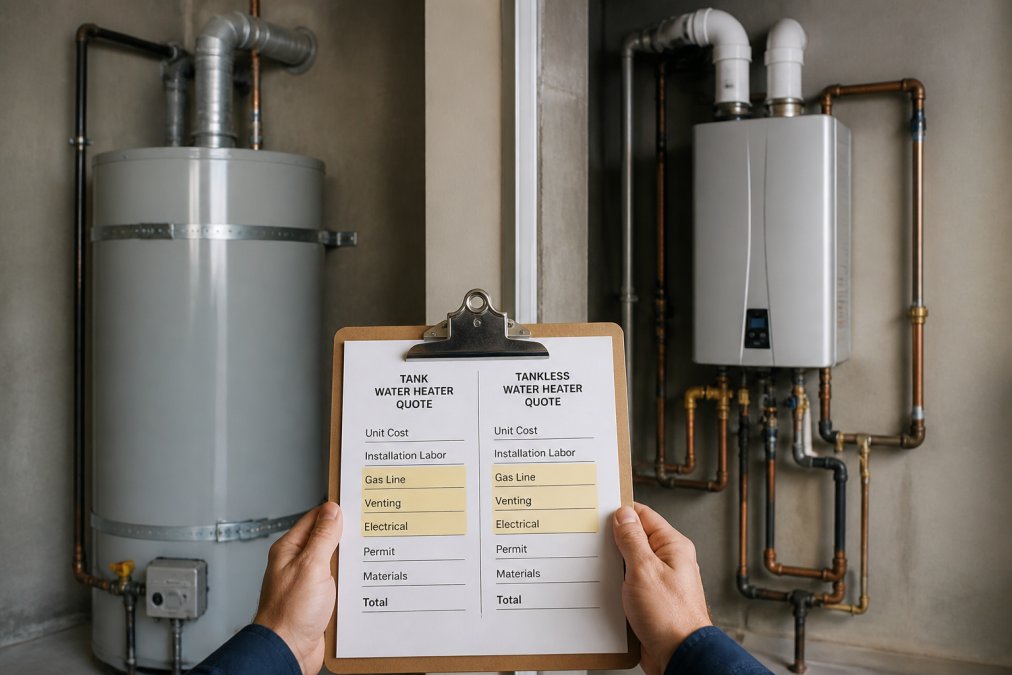
The Four Cost Drivers That Separate a Swap From a Conversion
When you compare quotes, look for these four line items. If a tankless quote does not address them, it is incomplete.
- Gas line capacity. Gas tankless units fire at a higher BTU input than a standard tank. A common residential gas line may be sized for the old tank and cannot deliver the required volume. Upsizing means new piping from the meter or manifold, skilled labor plus materials.
- Venting. Many condensing tankless models use PVC or stainless venting routed to code, with specific clearances and termination requirements; a standard tank’s metal flue cannot be reused. Non-condensing units may use a different vent type, so the venting line item depends on the model.
- Electrical supply. Gas tankless units still need power for controls and fan, and electric tankless units draw significant amperage. Electric models often require a dedicated circuit, sometimes a panel upgrade, an electrician’s scope, not a plumber’s.
- Condensate management. Condensing tankless units produce acidic condensate that must be neutralized and drained per code, adding a neutralizer, drain line, and sometimes a pump if gravity drainage is unavailable.
Why the Same Model Can Produce Two Very Different Quotes
A tankless quote is not comparable to another unless the scope matches. One contractor may price a straight unit swap and assume the existing gas line and venting are adequate; another may include line upsizing, new venting, a condensate neutralizer, and a permit. The second quote looks higher, but it reflects the actual job.
Swapping a tank for a tankless unit without checking your gas line size or electrical panel capacity is a common and expensive mistake. The unit fits, the install fails inspection, and you pay twice.
Gas Line Modification and Venting Requirements
Gas tankless units pull more BTUs than a standard tank, so the existing gas line may be undersized; upsizing means new piping and skilled labor. Venting also differs: many tankless models use PVC or stainless venting routed to code, not the metal flue your old tank used.
- Vent length and termination. Tankless venting has maximum equivalent-length limits and specific termination clearances from windows, doors, and intakes. A long or awkward route can push the venting line item up quickly.
- Combustion air. Some installations require a dedicated combustion air intake, especially in tight utility closets, another line item a like-for-like tank swap never includes.
Electrical Circuit Upgrade for Tankless Units
Electric tankless units draw serious amperage. Many homes need a dedicated circuit and a panel upgrade, an electrician’s job, and a line item homeowners rarely anticipate. If your panel is already full, budget for that work before you buy the unit.
A Simple Way to Compare the Two Quotes
Put the tank quote and the tankless quote side by side and check four things: unit price, labor, permit and inspection, and the four conversion line items above. If the tankless quote is missing any of the four, ask why. The answer tells you whether the estimate is complete or whether the surprise is waiting for install day.
Water Heater Installation Labor Rates and What They Cover
Water heater installation labor rates vary by market, job complexity, and whether the work is a straight swap or a conversion. Labor covers removal of the old unit, connection of water and gas or electrical lines, testing, and cleanup, but not always permits, disposal, or code upgrades, so read the scope.
Quote Breakdown: What a Fair Estimate Includes
A fair estimate should read like a checklist, not a mystery. Here’s what to look for:
| Line Item | What It Covers | Why It Matters |
|---|---|---|
| Unit price | Tank or tankless model, capacity, warranty | Sets your baseline cost |
| Installation labor | Removal, connection, testing, cleanup | The bulk of skilled work |
| Permit and inspection | Local plumbing permit and final inspection | Required for code compliance |
| Disposal fee | Hauling and recycling the old unit | Often billed separately |
| Code upgrades | Expansion tank, relief valve, flex lines | Prevents failed inspections |
| Gas or electrical work | Line upsizing, circuit upgrade | Common with tankless |
Customer-Supplied Unit: When It Saves You Money and When It Does Not
Buying your own unit can save money on equipment, but it shifts warranty risk to you. Many manufacturers tie the warranty to professional installation, so a self-supplied tank may void coverage if the install isn’t documented to their standard. You also lose the plumber’s ability to source a unit that fits your home’s venting and gas setup, so the savings are smaller than they look once warranty exposure is factored in.
Signs You Need a New Water Heater (Not Just a Repair)
Signs you need a new water heater usually start small: rusty water, rumbling sounds, or inconsistent hot water. A tank past its expected lifespan, leaking from the base, or showing corrosion on the fittings is usually a replacement, not a repair.
Repair vs Replace: The Decision Point
Use this rule: if the repair costs a meaningful share of a new unit and the tank is already near the end of its lifespan, replace it. A single failed part on a young tank is worth fixing. A leaking 12-year-old tank is not.
- Age past expected lifespan: lean replace
- Leak from the tank body: replace
- Rusty or metallic-tasting hot water: replace
- One failed part on a newer unit: repair
- Repeated repairs in a short window: replace
Hidden Costs of Code Compliance and Disposal
Code compliance and disposal are the two lines homeowners most often forget. Building code compliance can require a thermal expansion tank, a new pressure relief valve, or updated flex lines and PEX piping, even on a simple swap. These aren’t upsells. They’re what the inspector looks for.
Plumbing Permit and Inspection Fees
Most jurisdictions require a plumbing permit for a water heater replacement, and the work has to pass a final inspection. The permit and inspection fee is usually a fixed charge, but skipping the permit can cost far more if you sell the home or file an insurance claim. Check the [U.S.
Disposal and Recycling Logistics
Old tanks are heavy and don’t go in regular trash. Disposal and recycling usually involve a haul-away fee, and some areas have specific rules for draining and recycling the unit. Ask whether disposal is included in your quote or billed separately.
Photograph the model and serial plate on your old unit before it’s hauled away. That photo gives you the exact capacity, age, and warranty status, which makes comparing quotes far easier.
Maintenance Cost-Benefit Analysis: Protecting Your Investment
A maintenance cost-benefit analysis for a water heater is simple: small, regular upkeep extends lifespan and avoids emergency replacement. Flushing the tank to remove sediment, testing the pressure relief valve, and checking the anode rod are the three tasks that matter most. Sediment forces the burner to work harder, and a worn anode rod lets the tank corrode from the inside.
The Three Tasks and What Each One Actually Does
- Flushing the tank. Sediment settles on the bottom of the tank and insulates the burner from the water, so the burner runs longer to reach the set temperature, raising energy use and shortening tank life. Flushing removes the sediment. In hard-water areas, the interval may need to be shorter than once a year.
- Testing the pressure relief valve. This valve is a safety device, not a performance part. It should be exercised periodically to confirm it opens and reseats. A stuck valve is a safety issue, not a cost issue, and it is one of the few maintenance items that is not optional.
- Checking the anode rod. The anode rod is a sacrificial metal that corrodes instead of the tank lining. Once it is consumed, the tank itself starts to corrode. Replacing a spent anode rod is one of the least expensive interventions available, and the single item most likely to extend a tank’s service life.
The Cost-Benefit Math in Plain Terms
A maintenance cost-benefit analysis compares two numbers: the cost of upkeep over the tank’s remaining life, and the cost of replacing it earlier than necessary.
- Upkeep side. Annual flushing plus a periodic anode rod check is a modest recurring cost. If the anode rod is replaced once or twice over the tank’s life, that is a small fraction of a new installed unit.
- Replacement side. A premature replacement means paying for a new unit, labor, permit, and disposal years earlier than the tank’s expected service life would require.
When Maintenance Stops Paying Off
Use these signals to decide whether to keep maintaining or start budgeting for replacement:
- Leak from the tank body. No maintenance task fixes a failed tank shell. Replace.
- Corrosion at the fittings or base. Once corrosion reaches the tank itself, the anode rod has already lost the race.
- Repeated repairs in a short window. If you are paying for repairs more than once in a year or two, the maintenance budget is better spent on a replacement.
- Age past expected service life. Maintenance can extend life, but it does not reset the clock. A tank near the end of its expected life is a replacement candidate regardless of how well it was maintained.
The Quote-Audit Angle Most Guides Miss
When you get quotes, ask each contractor two questions:
- Does the quote include a new anode rod or a flush as part of the install? On a new tank, the anode rod is already new, so this is less relevant. On a tank that is being repaired rather than replaced, it matters a great deal.
- Does the quote include a maintenance recommendation with a specific interval? A contractor who tells you to flush annually and check the anode rod at a set interval is giving you a plan. A contractor who hands you a lump sum and no maintenance guidance is not.
Ask your contractor to note the anode rod type and the recommended inspection interval on your invoice. That single note turns a one-time replacement into a maintenance schedule you can actually follow.
Annual flushing and a mid-life anode rod check can push a tank well past its expected service life, a little maintenance now beats a surprise replacement later. The caveat: maintenance is a bet on the tank’s remaining condition. When the tank is already failing, the money is better spent on a replacement you can plan for.
Conclusion
Replacement costs are predictable once you know which lines to expect: unit, labor, permit, disposal, and code upgrades. The homeowners who get burned compare lump sums instead of line items.
Frequently Asked Questions
What is a fair price to replace a water heater?
A fair water heater replacement cost estimate depends on the unit type, tank size, and whether your home needs code upgrades like a thermal expansion tank or new venting. Tank units generally cost less to install than tankless because tankless often requires gas line modification or an electrical circuit upgrade. The best way to judge fairness is to request a line-item quote that separates the unit price from installation labor, permit fees, and disposal. A quote that lumps everything into one number makes it hard to compare.
How much does it cost to install a new water heater including labor?
Installation labor rates for a standard tank swap are usually the smallest part of the bill when no code corrections are needed. Costs climb when the job requires new flex lines, pex piping changes, a pressure relief valve replacement, or a plumbing permit and inspection. Tankless installs add more because of venting requirements and possible gas line or electrical work. Ask your plumber for a quote breakdown that lists labor separately so you can see exactly what you are paying for.
How much does a 40-gallon vs. 50-gallon water heater installation cost?
A 50-gallon tank costs more than a 40-gallon tank, both for the unit itself and often for the labor because of the larger size and weight. The gap widens if your home’s existing connections, venting, or electrical circuit cannot handle the larger unit without modification. Sizing matters more than the price difference: a 40-gallon tank may run out of hot water for a family of four, while a 50-gallon tank costs more upfront but meets higher demand. Match the tank to your household size first.
What are the hidden costs associated with water heater replacement?
The most common hidden costs are code compliance items that only surface during installation. These include a thermal expansion tank, a new pressure relief valve, upgraded venting, gas line modification, or an electrical circuit upgrade. Disposal and recycling fees for the old unit are another line item some quotes leave out. Permit and inspection fees also vary. A transparent estimate lists these as separate line items so you are not surprised when the final invoice arrives.